


Convenor responsibilities at EASA2026
Convening is a great opportunity, but also a serious responsibility – of representing colleagues, the conference, the discipline.
Here is a quick summary of your pre-conference tasks:
- ensure you’ve familiarised yourselves with the FAQs page
- you must be a member of EASA for 2026, we encourage you to re-activate or sign up for membership (or special status if not eligible) now, to ensure there are no delays in July!
- facilitate circulating the call for papers from your end
- be prompt in marking up your papers
- communicate closely with your authors and discussants/chairs by:
- answering their questions
- reminding them to register
- figuring out the best sequence of presentations
- advising newcomers on the length of presentations
- discussing scheduling
- marking up and informing us of withdrawals
- At least one convenor must be present in person at the conference for the panel or roundtable session, in the cases where some convenors need to attend online.
- All sessions should be in English language only, and accept papers in English also.
- The conference is fully hybrid and supported by a team of administrators. This means that convenors do not need to set up or run their zooms on the week, this will be done by a tech team and supported by a team of local volunteers (more information to come soon).
Convenors tasks in the panel management system
Accessing the panel and roundtable management page
To view/edit your panel or roundtable, and view proposals received so far:
- Go to the EASA2026 website and click on ‘Log in’ (in the banner above the EASA logo at the top), using your email and password when prompted. We suggest ticking ‘Remember me’ to stay logged in, if using your own computer, as this makes life easier later.
- Once logged in, the icon ‘Log in’ becomes ‘Logged in’ with a drop-down menu. Select ‘conference’ there and select EASA2026 from the drop down which says ‘current’ (you can bookmark this page to find it easily next time). Click ‘edit panel’ (the pencil symbol under ‘edit’ next to the title) to drill down into the detail: title, abstracts and, listed below, any proposals.
If you update any fields, remember to click the ‘Save’ button. At this stage the status of all proposals is ‘Pending’.
Marking proposals
See the dedicated page for instructions about maximum numbers, how to do it etc. Proposals need to be marked by 9 March.
No transfer process
During the call for papers, we had considered the possibility of running the transfer process which many of you are familiar with from the previous EASA conferences. However, this year the call for papers resulted in many panels being incredibly over-subscribed.
This means that any papers set to transfer would have to compete for a very small number of spots: most likely nearly one thousand of transferable papers would have had to compete for ten or so vacant spots. Such a disproportion deems this year’s transfer process unviable: putting authors through such a challenging selection, along with the added pressure on convenors to consider even more papers, would have been unfair to both. This means that there will be no transfer process this year.
Emailing authors – VERY IMPORTANT!
When you mark up a paper, the decision will show in the author’s platform. However, the panel management system does not send an email to the author alerting them of the status change, so please do your colleagues the courtesy of sending them an email informing them of your decision.
To make this easier click the ‘Send email’ button at the top of the panel edit page and choose which subsets of authors you wish to write to, and which method you wish to use to generate an email.

Acceptance & Visa support letters
Conference participants are entitled to receive a letter of support for visa or funding applications. From time to time, presenters may contact panel convenors to request such letters, and panel convenors themselves may likewise occasionally require similar documentation.
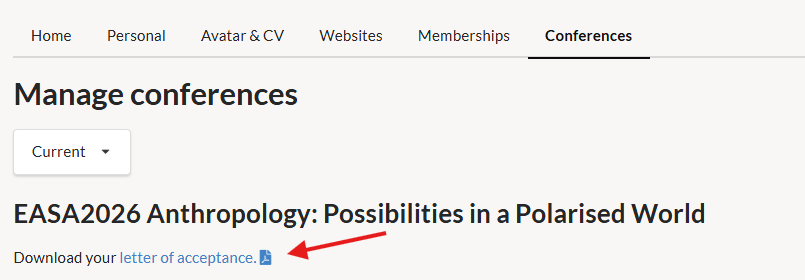
Please note that there is a difference between acceptance letters and visa support letters. all active participants can download acceptance letters from the system; but visa letters need to be requested differently – from the conference administrators who then issue them.
Acceptance letters are available on each person’s account if their paper or panel has been accepted for EASA2026. The aceptance letters are designed to help with institutional funding applications, time off work, and proof of acceptance for other related reasons.
Visa support letters are a different type of letter: to make sure visa support letters are robust enough for the visa application process, the conference organisers need to gather some more information from the requesting participant. The participants will be able to provide this information via the form on the visa page under travel info on the website.n.b. the visa letter has not been finalised yet, this will be available on the website before the start of March.
Subsequent actions
Number of sessions
Panel is a collection of papers organised by a convenor around a specific topic. Sessions are time slots of which a panel consists. Depending on the number of papers, a panel may consist of one, two or three sessions. In this case we say that a panel has one, two or three sessions allocated.
Session numbers were allocated based on the number of papers a panel is allowed to accept, there is no need to request a second session if you have more than 5 accepted papers. All sessions are 105 minutes long, and should have no more than five papers allocated, but may have fewer and still have the full session time. For example, a panel with seven accepted can be split over two sessions as 5+2 or as 3+4, etc. (the sessions remain 105 minutes in length when they contain fewer than 5 papers, allowing greater flexibility in presentation and discussion timing).
Timetabling requests
When all convenor decisions have been made, we will allocate your panel the appropriate number of sessions.
If you are aware of any limitations to the timetabling of your panel, you will be able to state this in the system. We will send some detailed instructions on how to make a request in the available box, and what this should include, so please hold back from making requests at this stage if you can.
In the meanwhile, we recommend sending a quick round of emails – sometimes authors have pressing reasons to request for the panel to avoid a certain day, and it is a good idea to negotiate this before informing us. Note that we are already aware via our software of participants’ roles as convenors, presenters, chairs or discussants in various sessions, so you do not need to inform us.
Please note: panels with three or four sessions must be willing to be scheduled (at least partly) on the Friday, 24 July. Friday is the last day of the conference and the only one with three session slots – all preceding days have two sessions each.
Decide on your panel’s line-up
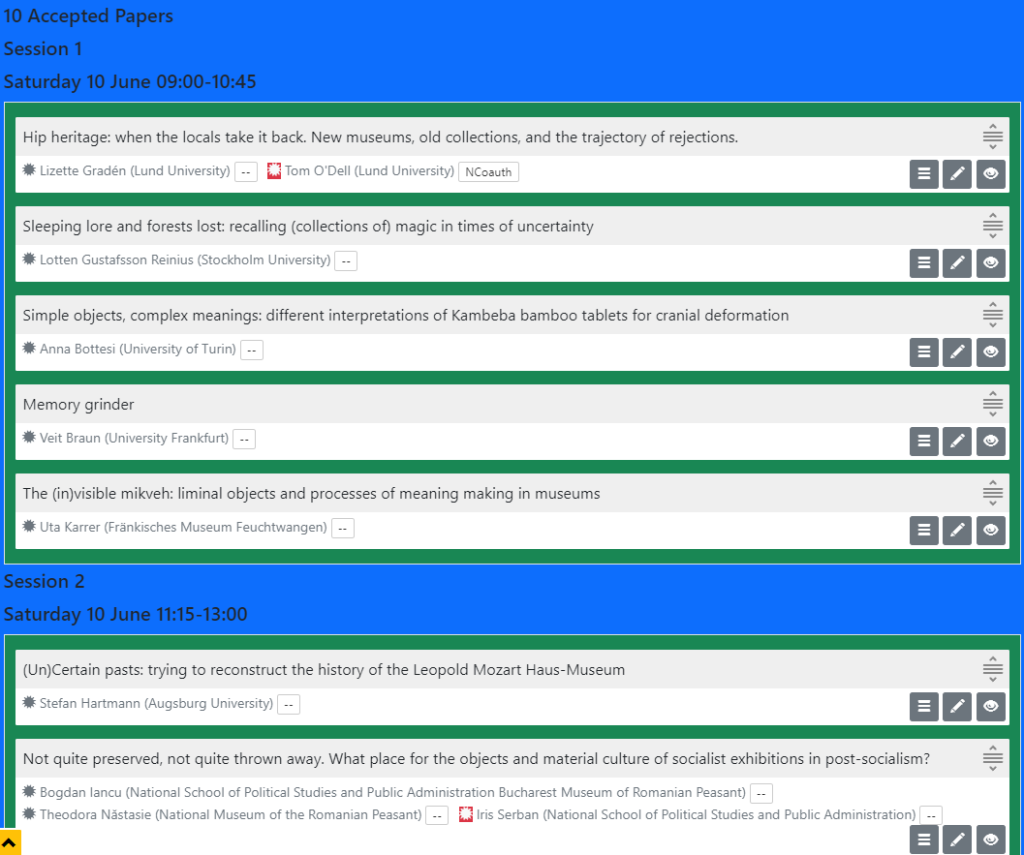
Once we’ve allocated your panel the requisite number of sessions, please return to the panel edit page to drag papers into the different sessions and/or to update the presentation order.
Polish your panel abstracts
As convenors, you have editorial control over your contributors’ papers. We do not offer proofreading services to the conerence participants – rather, it is both the convenors and the authors responsibility to proof the accepted abstracts. This is how they will be published in the conference booklet, so please make sure that all the abstracts in your panel look neat.
Prior circulation of papers
EASA does not require prior circulation of papers; however if you wish to do this for your panel, the panel page can help avoid a lot of emailing to and fro: each author can upload a PDF of their paper (not of their abstract!) into their paper edit page and this is then available to co-panelists for download from your panel page on the site. If you subsequently wish these to be available more widely, please let us know so we can alter their visibility to delegates or public.
Convenors checklist (for later)
☑️Contact details
The fields from the Manage Account page (click Manage Account from the logged in drop down) that end up on the delegate badge are your name and institution. It is perfectly fine to not indicate an affiliation if you are an independent researcher/practitioner etc. However, you may have forgotten to insert the information when entering your details for the first time, and in fact want to show your affiliation. If that is the case, do add it and remember to click “Update” once done!
You can also add a short biography and even a portrait/avatar here, which can then be seen in the online programme.
☑️Editing abstracts
We use “sentence case” (as opposed to “title case” style) for panel and paper headings (only the first word and proper nouns have initial capitals). We will be editing all the titles to follow the sentence case style – please don’t re-capitalize them.
Please check if you need to update/edit/change the short abstract you currently have in the system for your panel. Click “Save my changes” once you are done with editing. Please remember to keep to the correct character count (max 300 characters, including spaces).
Once conference registration opens in March, please encourage your authors to register as soon as they can, and let us know of those who cannot attend so we can remove those abstracts from the programme.
If possible: it would be a great help to us if you could edit your panel/roundtable titles and abstracts to use British English spelling so that the titles are consistent across the programme, particularly with the use of the word Polarised / Polarisation this year =)
First time a convenor at EASA?
Do I have to inform authors of acceptance/rejection?
We do inform authors of outcome and give them all the relevant information, such as travel details, venue locations, registration, funding and more. However, we recommend that the acceptance first come from their convenors, this helps establish a relationship and give them a point of contact for those questions which administrators cannot answer, about the academic content of the session.
What does it mean to have multiples?
EASA conferences have a one role once per conference rule. This means your authors who have more than once acceptance will need to make a choice of which to present, and may not keep both.
Is there a deadline for registration?
Active participants, which includes convenors, authors, discussants and chairs (face-to-face, or online), MUST register in advance to the conference. In order to confirm participation and remain listed in the programme, they must register by the early bird closing date of 1 June 2026. Any unregistered content after this point will be withdrawn. Registration remains open after for those who do not have accepted content in the conference.
What is the difference between a panel and a session?
Panel is a collection of papers organised by a convenor around a specific topic. At EASA2026, each convenor can organise only one panel.
Sessions are time slots of which a panel consists. Depending on the number of papers, a panel may consist of one, two or three sessions. In this case we say that a panel has one, two or three sessions allocated.
Membership
Convenors and authors must be EASA members for the year of 2026 and have settled membership fees in order to present at the conference. Conference delegate funding cannot be used to cover association membership fees, so this should not be delayed based on this.
Does the conference publish papers in a monograph?
The conference does not have an official monograph publication for accepted content. However, convenors who wish to can offer to organise paper publication through journals independently.