
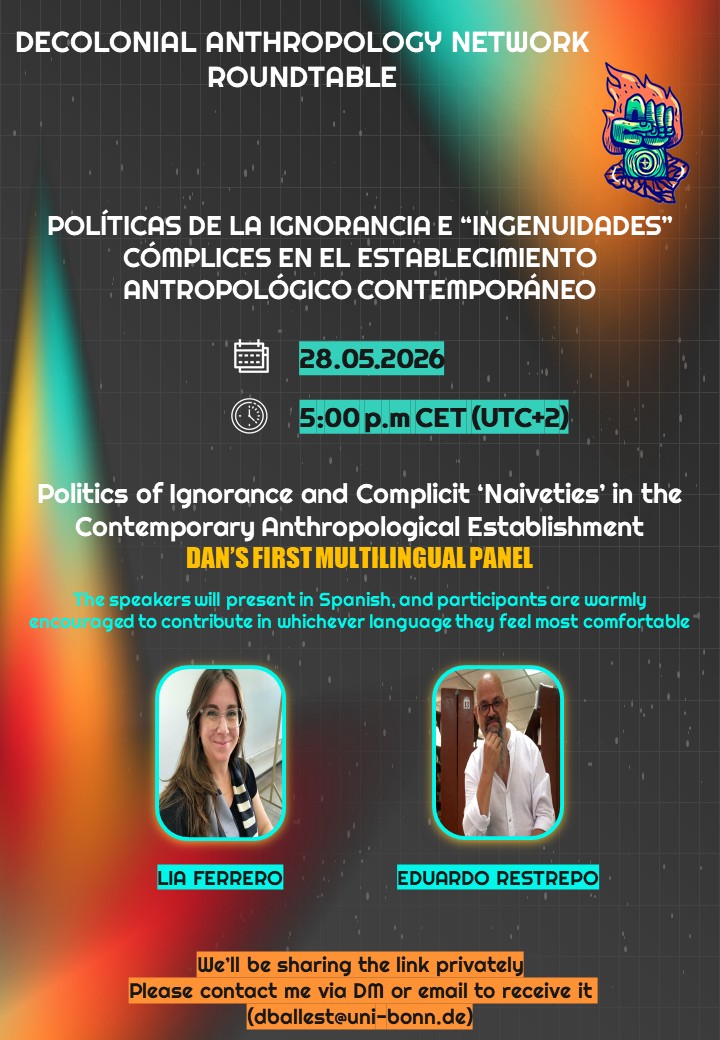
On May 28, the second DAN roundtable, “Politics of Ignorance and Complicit ‘Naivetés’ in the Contemporary Anthropological Establishment,” took place with the participation of Lía Ferrero and Eduardo Restrepo. The event brought together nineteen participants in a discussion shaped by a shared concern: to interrogate the conditions of possibility for anthropologies that, while claiming to be decolonial, continue to reproduce silences, hierarchies, and mechanisms of legitimation deeply rooted in the coloniality of knowledge.
The discussion was organized around two guiding questions. The first focused on the concrete mechanisms—editorial, institutional, affective, and economic—that enable the reproduction of silences surrounding internal colonialism within the discipline. The second sought to problematize the ways in which the academic establishment of the Global South reproduces categories, theoretical fashions, and criteria of validation generated in the centers of the Global North, asking to what extent this dynamic reflects external imposition or a strategic choice linked to recognition and funding.
From the outset, Lía Ferrero proposed a situated reading, both geopolitically and epistemologically. Drawing on her experience in decision-making spaces within local, regional, and global anthropological associations, she noted how these trajectories had led her to recognize both certainties and uncertainties regarding what it means to “decolonize” anthropology today. In this context, she emphasized that these debates are far from new and can be traced back to discussions of the 1960s and 1970s, when the discipline still retained a political density that now appears to have been significantly diluted.
Eduardo Restrepo’s intervention deepened this line of analysis by arguing that so-called “politics of ignorance” are neither accidental nor the result of a spontaneous absence of knowledge; rather, they are actively produced. Ignorance, he maintained, is manufactured through specific technologies, institutional arrangements, and concrete forms of circulation of academic prestige. In this sense, politics of ignorance constitute the very reverse side of the canon: that which determines what counts as legitimate knowledge and what is relegated to silence, erasure, or invisibility.
Eduardo organized this problem around four dimensions. First, the political economy of academic production, understood as the unequal distribution of material and symbolic resources that generates hypervisibility for some forms of knowledge while rendering entire areas opaque. Second, the geopolitical dimension—drawing on Esteban Krotz’s notion of anthropologies in or from the South—where the locus of enunciation emerges as a relation of power rather than a mere geographical location. Third, the processes of hegemonization and subalternization that shape which voices acquire authority and which remain permanently marked as peripheral. Finally, he highlighted normalization as a central mechanism of disciplinary reproduction: the process through which particular practices, readings, and sensibilities come to appear as self-evident and natural.
In dialogue with these ideas, Lía argued that many of the intellectual and political struggles of the 1960s and 1970s were gradually absorbed by the academic system itself. What once possessed disruptive potential has often been reduced to a repertoire of morally acceptable yet politically emptied formulas. From this perspective, decoloniality risks becoming an institutional slogan rather than an effective critical practice. It is not enough, she argued, to incorporate superficial gestures of inclusion—such as inviting a “native” intellectual or a scholar from the Global South—if such incorporations fail to alter the deeper structures through which knowledge is produced.
At this point, the discussion also turned to Achille Mbembe and the historical production of sacrificial subjects within colonial modernity. The question of visibility was critically examined: not all visibility implies emancipation, nor does all recognition necessarily transform relations of power. Consequently, decolonizing anthropology cannot be reduced to expanding representation; it requires rethinking the discipline through the very relations that have historically constituted subalternity.
The second part of the conversation focused on academic recognition and forms of intellectual disciplining. Eduardo emphasized that those who pass through anthropology are affectively and institutionally shaped by the discipline itself. Anthropological training does not merely cultivate skills; it also produces emotional dispositions, loyalties, and blind spots. This helps explain the difficulty of undertaking an “anthropology of anthropology”: developing critical distance from one’s own discipline entails confronting deeply entrenched mechanisms of identification.
In this regard, he noted that even colleagues occupying positions of considerable academic power and enjoying privileged access to resources often remain unable to perceive these processes of alignment with the canon and the ways in which they structure the discipline. Anthropology generates narratives that ultimately come to be consumed as unquestionable truths, accompanied by forms of “disciplinary patriotism” that reinforce hierarchies and intellectual loyalties. In the peripheries—and especially in the peripheries of the peripheries—this phenomenon becomes even more pronounced, as critical labels themselves often end up subordinated to other hegemonic categories.
Lía returned to this issue by emphasizing the central role of international recognition. When the Global North grants access or visibility to a scholar from the Global South, she explained, this is often experienced as a decisive form of validation. Yet such recognition frequently depends upon prior conformity to the dominant canon: citing the “right” authors, adopting the appropriate language, and accommodating the expectations of the center. This alignment may occur consciously or unconsciously, but it remains one of the most effective mechanisms for reproducing intellectual dependency.
At the same time, she observed that in Latin America a split often emerges—both as a gesture of distancing and differentiation—between academic careers and political activism. While institutional trajectories require adaptation to specific criteria of legitimacy, Latin American identification is frequently displaced into activism or forms of political engagement outside academia. In this context, she also questioned certain forms of paternalistic benevolence within contemporary academia: a logic that transforms subalternized subjects into moral objects of symbolic validation rather than recognizing them as genuine political interlocutors.
Toward the conclusion, the discussion returned to the need to recover an anthropological practice capable of reinstating political sensibility at the center of knowledge production. Rather than multiplying slogans of inclusion or expanding decolonial rhetorical repertoires, the conversation emphasized the urgency of interrogating the material, affective, and geopolitical conditions that sustain the contemporary anthropological field. In this sense, the roundtable left participants with a question that resonated throughout the event: whether it is possible to imagine a genuinely decolonized anthropology without simultaneously transforming the structures of recognition, funding, and legitimacy that organize contemporary academia.