Current ecological upheavals are typically attributed to human activity within what is known as the Anthropocene (the age of humans). This period is defined by humanity’s transformation of its environment, especially through its impact on all forms of life—human, animal, and even mineral—seen to be interdependent. Although its exact starting point is debated, the late eighteenth century is often identified as pivotal, with the invention of the steam engine and the rise of the Industrial Revolution in Europe. Among its many effects, the Anthropocene has significantly impacted animals by disrupting ecosystems and natural habitats, placing numerous species at risk of extinction.
The concept of the Anthropocene has been widely criticised for portraying humans as separate from other species, and both responsible for the crisis and capable of solving it. This anthropocentric view has long reinforced a binary opposition between humans, associated with culture, and animals, linked to nature, granting humans a sense of superiority. In contrast, the philosopher Donna Jeanne Haraway proposes understanding humans as “companion species” with animals and other earthly beings, encouraging attention to their well-being as they both co-create shared futures. This perspective invites one to consider the entangled relationships between humans and non-humans, where the animal world is no longer seen as radically other but as part of a complex web of interconnected life.
From its very beginnings, anthropology has incorporated both humans and nonhumans into its ways of classifying living beings. More recently, movements to decolonise thought have brought questions of environment, ecology, and multispecies relations into broader anthropological efforts to decentre anthropocentric ways of thinking. My own ethnographic observations among neo-shamanic practitioners who engage with animals are part of this endeavour.
Neo-Shamanism: Reconnecting Human and Non-Humans
In traditional shamanism, animals are generally regarded as actors with whom one interacts, sometimes for survival within a power relationship that is not necessarily in favour of humans. Anthropologist Charles Stépanoff explains that in shamanic societies of the Arctic region, hunting and animal husbandry practices are grounded in specific conceptions of and relations with animals. Examining hunting techniques and ritual treatments of the bear in various Siberian societies, Stépanoff shows that once killed, the bear’s body may become food or a talisman (such as paws). Yet, while alive, it is treated as a being capable of understanding human language, with whom one must engage in social relations (as among the Altai-Sayan Turks), or as a species belonging to the human world and capable of occupying an honoured place within it (as among the Nivkh). These forms of subjectivity are based on animist principles according to which, although animals (and spirits) differ in appearance and habitat from humans, they share a common nature that enables interactions.
In the neo-shamanic milieus I have observed in Quebec (Canada), I have found similar forms of interaction and entanglement between humans and animals. The practitioners I have encountered there are directly inspired by the transcultural shamanism initiated by anthropologist Michael Harner. As discussed by Denise Lombardi, this version promotes the “core of neo-shamanism”—that is, its fundamental and shared elements—by extracting them from cultural contexts in order to make them accessible to Western audiences. Interestingly, unlike more traditional forms of shamanism, neo-shamanic imaginaries tend to conceive non-human entities as benevolent actors endowed with infinite compassion for the humans who address them for divination or healing purposes. In this regard, it contrasts with certain Christian interpretations that derive from the Bible a divine licence for humans to “dominate” the non-human world. Since Lynn White’s thesis, and despite Pope Francis’ encyclical Laudato si, many neo-shamanic practitioners view the Christian matrix of Western societies as largely responsible for the current ecological crisis, associating the rupture of a sacred connection with nature with contemporary environmental problems. Shamanism thus appears to them as a valuable resource for restoring this connection.
Ritual Innovations to Build Care and Reciprocity in Human-Animal Relationships
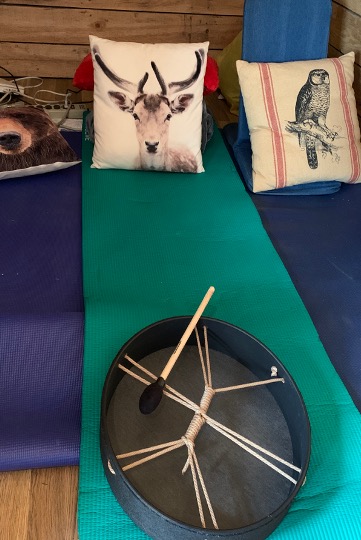
Neo-shamanic practitioners typically lead circles in which participants journey into other worlds to the sound of drumming in order to encounter spirits offering healing or guidance. Most of these interactions occur with animal spirits who are highly valued for the specific medicine each one carries. For example, the skunk guides toward the acceptance of one’s deeper nature and the release of wounds related to rejection. One practitioner I met offers healing circles with rescue horses: using shamanic tools to encounter the spirit of the horse and the great spirit of the horse, participants are invited to carry out healing rituals both for the horse and for themselves. Horses are presented here as sensitive beings attuned to their environment, whose histories of subjugation and quests for freedom resonate with those of humans. Their behaviours and their own wounds thus act as mirrors of the participant’s internal states. Among the three horses on the small farm, a participant who was experiencing loneliness was guided to work with Sugar, a former racehorse who had been neglected following an accident: her healing ritual consisted of hugging Sugar in a gesture of affection and then brushing his tail as a form of care. Horses and humans are thus placed in a reciprocal relationship grounded in the principle of mutual well-being, reversing traditional hierarchies of power and knowledge.
This process introduces a specific anthropology in which human and non-human beings connect with one another for the sake of a shared collective healing. In this view, shamanic ritual experiences facilitated by animals form part of a new type of ecological ritual of collective reconciliation grounded in respect for non-human life.