

Want to know how to avoid being tricked by fake emails? Below are some no-nonsense rules you should follow:
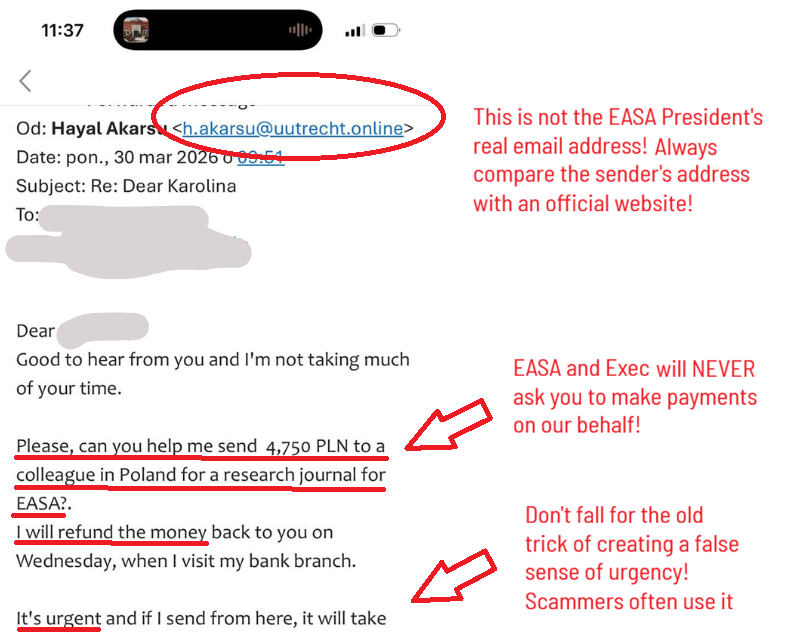
1. Always check the sender’s email address
- Do not trust the display name – it can be fake
- Carefully check the full email address (after @)
- Official emails come only from verified EASA domains
- Watch for small changes such as:
- @easa-online.org
- @easaonline.com
…instead of the EASA real domain. If in doubt, check the official EASA website or contact EASA directly.
All genuine conference communication will originate from the conference(at)easaonline.org, while membership-related communication will originate from membership(at)easaonline.org.
2. Be suspicious of urgency or pressure
Scammers often try to rush you so you do not have time to think.
Common phrases include:
- “It’s urgent”
- “I need this done quickly”
- “I’m unavailable right now”
- “Please act immediately”
Legitimate requests do not pressure you to act immediately.
3. EASA will NEVER ask you to send money on its behalf
- No transfers
- No gift cards
- No “temporary help” payments
- No donations
If someone asks for money in a personalized email, always treat it as a scam.
4. Look for unusual behavior
Be cautious if:
- The tone is unusual, overly formal, or desperate
- The request is unexpected
- You are asked to keep the request confidential
If something feels wrong, always check with the EASA through our official channels.
5. Double-check before acting
- Contact the person through a different channel (official email, phone, or website)
- Ask a colleague if you are unsure
- Take time to verify before responding
6. Never share sensitive information
Do not send:
- Bank details
- Passwords
- Personal data
7. Golden Rule
When in doubt: do not respond, do not pay, and verify first using the EASA official channels!
Scam attempt example:
For other scam examples, please see here: