June 21, 2025. Summer Solstice. We take the students in my summer field school to see the sacred well of Santa Cristina, a late Nuragic site near Paulilatino consisting of a ritual well surrounded by a variety of outbuildings. As we approach the well, we note a group of about twenty people in colourful capes and tunics clustered around the opening. One seems to be a ritual leader; he holds a pitcher and is intoning a prayer or chant. I am dying of curiosity, but decide to keep our group back until the devotees are finished with their ceremony. I try to catch a few words of the prayer, and intuit that this is one of the New Age groups that visits the sanctuary on solstices and equinoxes.
Sardinia: A Place to Heal, A Place to Reconnect
Sardinia, an island province of Italy in the western Mediterranean, is one of the most archaeologically rich territories in Southern Europe, with thousands of sites ranging from the early Neolithic (ca. 8000 BCE) to the late Roman and early Christian eras (300-400 CE). There are well over 7000 nuraghi, Bronze Age stone towers unique to Sardinia, scattered throughout the island, in addition to Giant’s Tombs (prehistoric megalithic burials), sacred wells, and Neolithic necropolis known as domus de janas, or “homes of the fairies.” These remarkable examples of dry-stone architecture and engineering are set against stunning Mediterranean landscapes, making them compelling attractions for tourists from around the globe.
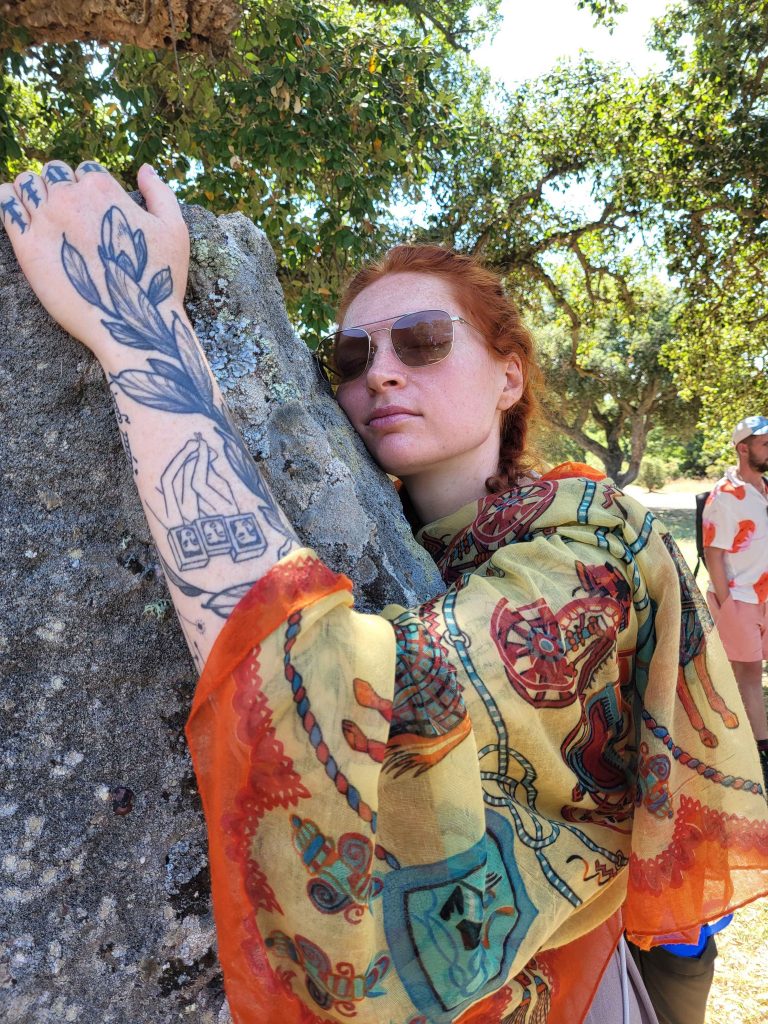
Beginning in the late 20th century, some of these sites have become the focus of spiritual archaeo-tourism. Spiritual archaeo-tourism can be found at heritage sites throughout the globe; ethnographers have documented it at Stonehenge and Avebury in England, as well as at megalithic sites in Crete, Malta, Scotland, Ireland, Belgium, and France. Rooted in alternative religions, the New Age movement, and feminist or goddess spirituality, spiritual archaeo-tourism involves eclectic, individualised ritual practices at heritage sites, including activities such as sensing and absorbing the energy of the stones, leaving offerings, and theatrical rituals with costumes, drumming, and music. The purpose of the practices is to connect with the site’s past history and receive physical or energetic healing: stones are thought to be imbued with energy or vibrations that can be transmitted to the human body in order to achieve a healing effect. Visits are often timed to coincide with significant astronomical and seasonal shifts, such as the solstices and equinoxes, with which some of the structures align. Practitioners typically visit in small groups. They generally do not belong to any single religion, sect, or cult, and may not necessarily share common beliefs or religious leaders. Visits may be self-organised, or formally organised by businesses specialised in New Age tourism.
Sardinia’s unique characteristics and the narratives surrounding them play an important role in attracting tourists. The presence of female figurines from both the Neolithic Ozieri culture and the late Nuragic period has been interpreted as evidence of the presence of goddess-centred matriarchies on the island in ancient times, and attracts practitioners of feminist spirituality and other goddess worshippers. Pseudo-archaeological interpretations linking Sardinia’s early inhabitants to the seafaring Mediterranean people known as the Shardana attract spiritual tourists seeking connection to an ancient Sardinian civilisation allegedly superior to those of other Mediterranean powers; frequently, these tourists share regionalist, anti-colonial sentiments. Finally, the 1980s novels of Sardinian author Raimondo De Muro have created their own brand of spiritual archaeo-tourism known as Sa Nuraxia. De Muro (1916 – 2015) published I racconti della Nurarcheologia (“The Tales of Nurarchaeology”), a six-volume work of fantasy, in 1983. The five interconnected novels tell the story of the decline of communal farming traditions in Sardinian families and communities through the eyes of a variety of characters; the sixth volume is a collection of Sardinian proverbs and charms. According to the author, together they preserve Sardinian ways of knowing and cultural traditions dating back to Nuragic civilisation, as maintained by farming communities until the late 20th century. The combination of traditional knowledge, ancestral codes of justice and behaviour, and folk healing techniques is known as Sa Nuraxia. De Muro was also a proponent of the Ancient Aliens hypothesis, a form of pseudo-archaeology according to which extraterrestrial aliens helped early Sardinians with sophisticated feats of architecture and engineering, creating nuraghi, sacred wells, and temples such as those found at Santa Cristina (Paulilatino) and Romanzesu (Bitti). According to De Muro’s novels, early Sardinians believed the space visitors were deities. This notion motivates some tourists to attempt to receive messages from extraterrestrials at the ruins.
Although De Muro’s books have long been out of print, they have inspired a number of community-based projects that attempt to keep the spirit of Sa Nuraxia alive, from local theatre productions and podcasts dramatising his stories, to community-based organic gardens connecting local elders and new migrants through shared food, cooking, and art. Among the many initiatives inspired by De Muro’s work are healing rituals situated in archaeological sites that aim to connect Sardinians today with the energies of their ancestors from long ago. Unlike other forms of spiritual tourism and the community initiatives mentioned above, these practices are limited to those who are ethnically Sardinian. Belonging is interpreted according to essentialist paradigms with a strong nativistic component: they are only open to individuals born and raised in Sardinia by Sardinian parents. Practitioners see this as a way of keeping traditions out of the hands of outsiders who would instrumentalise them for their own benefit, resisting the island’s long history of colonisation. Anthropologist Gianna Saba considers that in some cases, it also reflects their belief that Sardinians are superior to other peoples because they preserve a biological and/or cultural link to extraterrestrial aliens who visited the island in ancient times.
Understanding Spiritual Archaeo-Tourism in Sardinia
Whereas tourism forms a substantial part of the Sardinian economy, especially along the famed coastlines, spiritual archaeo-tourism constitutes only a relatively small component of the industry overall. Nonetheless, the reuse and reinterpretation of heritage sites is nothing new in Sardinia; archaeology shows they have been reused for millennia. Their contemporary reinterpretation as sources of healing energy connects to local vernacular beliefs: for example, the long row of standing stones at Pranu Muteddu are smooth from generations of women who have rubbed their bellies against them to ensure fertility; Nuragic centres were used as gathering places for celebrations well into the mediaeval period, to the consternation of Catholic clergy. Their use today as pilgrimage sites and centres of healing represents new understandings of place situated in contemporary ideologies. Today’s spiritual practices re-inscribe heritage sites according to new narratives and understandings of the past and its connection to the present. There, tourists participate in embodied practices that collapse time and space, creating spiritual links to the past as well as the future.
While archaeologists maintain clear distinctions between evidence-based interpretation and pseudo-archaeology, heritage managers and local communities negotiate these boundaries more pragmatically. As noted by G. Sabba, the Superintendency permits spiritual practices at archaeological sites only if they cause no physical damage, disrupt neither other visitors nor the sites themselves, and leave no material traces, while many heritage professionals criticise New Age interpretations for erasing the cultural specificity of Sardinian archaeology through universalising narratives of Mother Goddess worship or “cosmic energy.” Local cooperatives, however, often welcome off-season spiritual tourism for its economic benefits, and some guides accommodate contemplative forms of engagement alongside archaeological interpretation. Local communities have likewise shifted from initial curiosity and scepticism toward greater acceptance—and even pride—as sustained spiritual tourism has brought renewed attention and visitors to inland heritage sites.
The healing rites performed at heritage sites recall other forms of heritage reclamation in Italy, such as the reclamation of the pizzica and tarantella in Puglia and of vernacular healing as “shamanism” throughout Italy, as practitioners seek to connect to the past, search for direct contact with the numinous, and create meaning in the present.